

Accounting Time Blocking System: A Practical Workflow for Onboarding, Audits, and Month-End Close
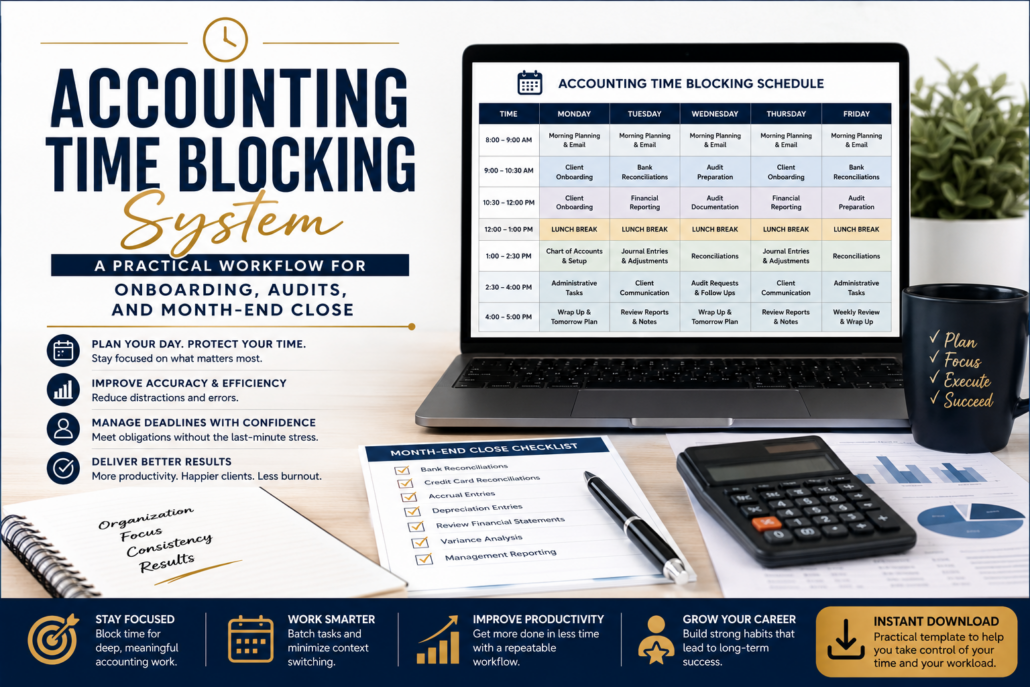
Accounting Time Blocking System: A Practical Workflow for Onboarding, Audits, and Month-End Close
Every accounting professional understands the challenge of balancing competing priorities. One moment you are responding to client emails, the next you are preparing reconciliations, reviewing financial statements, onboarding a new client, or supporting an audit request. Without a structured approach, the workday quickly becomes reactive instead of intentional.
That is precisely why an Accounting Time Blocking System can transform the way accountants manage their workload.
Rather than simply filling a calendar with meetings and reminders, time blocking creates dedicated periods for focused work. Consequently, it minimizes context switching, improves accuracy, and encourages consistent progress on high-value responsibilities.
Whether you are a staff accountant, bookkeeper, tax professional, controller, or finance manager, implementing a repeatable scheduling system allows you to work more efficiently while maintaining exceptional quality.
What Is Accounting Time Blocking?
Accounting time blocking is a productivity method that assigns specific periods of the day to predetermined accounting tasks instead of continuously reacting to incoming requests.
Instead of asking yourself, “What should I work on next?”, your calendar already provides the answer.
For example, a structured day may include:
- Client communication
- Bank reconciliations
- Financial reporting
- Audit documentation
- Administrative tasks
- Professional development
As a result, your work becomes significantly more organized and far less stressful.
Why Traditional To-Do Lists Fall Short
Although task lists remain valuable, they rarely answer one important question:
When will the work actually get done?
Many accountants maintain extensive lists of responsibilities without allocating sufficient uninterrupted time to complete them. Consequently, priorities shift throughout the day, deadlines become compressed, and important projects are repeatedly postponed.
Time blocking addresses this issue by transforming priorities into scheduled commitments.
Instead of hoping to find time, you intentionally reserve it.
A Practical Workflow for Modern Accountants
The Accounting Time Blocking System is designed around recurring accounting responsibilities rather than generic productivity advice.
Morning Planning
Begin each day by reviewing your priorities and identifying any urgent deadlines.
During this block you should:
- Review emails
- Confirm scheduled meetings
- Prioritize deliverables
- Identify potential bottlenecks
This planning period creates clarity before deep work begins.
Client Onboarding
New client engagements require uninterrupted attention.
Reserve dedicated blocks for:
- Collecting documentation
- Setting up accounting software
- Reviewing prior financial records
- Creating client folders
- Establishing communication protocols
Completing onboarding systematically reduces future errors and strengthens client relationships.
Audit Preparation
Audits often require concentrated effort.
Dedicated audit blocks allow accountants to:
- Organize supporting documentation
- Verify reconciliations
- Review journal entries
- Resolve discrepancies
- Prepare auditor requests
Furthermore, maintaining consistent audit preparation throughout the year significantly reduces last-minute pressure.
Month-End Close
Few accounting processes demand more discipline than the month-end close.
A structured schedule should include blocks for:
- Bank reconciliations
- Credit card reconciliations
- Accrual entries
- Depreciation entries
- Financial statement review
- Variance analysis
- Management reporting
Breaking these responsibilities into manageable sessions helps maintain accuracy while avoiding burnout.
Administrative Tasks
Administrative work often interrupts high-value accounting activities.
Instead of responding throughout the day, designate a single administrative block for:
- Email responses
- Internal meetings
- Calendar management
- File organization
- Software updates
By grouping similar tasks together, you preserve valuable focus during analytical work.
The Benefits of an Accounting Time Blocking System
Implementing a structured workflow offers several measurable advantages.
Improved Accuracy
Deep work reduces distractions, allowing accountants to identify discrepancies before they become larger issues.
Better Deadline Management
Scheduled work sessions ensure recurring responsibilities receive consistent attention throughout the month.
Increased Productivity
Batching similar tasks minimizes the mental effort required to transition between unrelated activities.
Reduced Stress
Knowing exactly what should be completed—and when—creates greater confidence during busy reporting periods.
Higher Quality Client Service
With fewer interruptions and improved organization, accountants can provide faster and more accurate responses to client requests.
Who Can Benefit?
This workflow is valuable for professionals at every stage of their accounting career, including:
- Staff Accountants
- Senior Accountants
- Controllers
- Bookkeepers
- Tax Professionals
- CPA Firms
- Outsourced Accounting Teams
- Finance Managers
- Accounting Students
- Freelance Accountants
Regardless of experience level, establishing consistent routines creates a stronger foundation for long-term success.
Expanding Beyond Time Blocking
The Accounting Time Blocking System represents only one component of a comprehensive productivity framework.
As your processes mature, you can build an entire library of complementary resources, including:
- Month-End Close Checklist
- Account Reconciliation Workflow
- Audit Planning Template
- Staff Accountant Interview Guide
- Accounting Job Search Workflow
- Excel Templates for Accountants
- Client Onboarding Checklist
- Financial Reporting Calendar
- Bookkeeping SOP Library
Together, these resources form a scalable Accounting Workflow Series that supports both individual professionals and accounting teams.
Final Thoughts
Accounting is fundamentally a profession built on precision, consistency, and disciplined execution. However, even the most skilled professionals can struggle when their schedules lack structure.
An Accounting Time Blocking System provides more than a calendar template—it establishes a repeatable workflow that encourages focused work, improves accountability, and supports sustainable productivity throughout the year.
Whether you are preparing for month-end close, coordinating an audit, onboarding new clients, or simply trying to manage an increasingly demanding workload, time blocking offers a practical framework for accomplishing more with greater confidence.
By implementing intentional scheduling today, you position yourself to deliver higher-quality work, reduce unnecessary stress, and build habits that contribute to long-term professional success.
Frequently Asked Questions
What is accounting time blocking?
Accounting time blocking is a scheduling technique that assigns dedicated periods to specific accounting tasks, helping professionals stay organized and minimize distractions.
Is this workflow suitable for small accounting firms?
Yes. Small firms often benefit the most because structured scheduling improves efficiency and helps teams manage multiple clients simultaneously.
Can bookkeepers use this system?
Absolutely. The workflow is ideal for bookkeepers who perform recurring tasks such as reconciliations, financial reporting, payroll, and client communication.
How often should I update my time blocks?
Review your schedule weekly and adjust it monthly to accommodate recurring reporting cycles, seasonal workloads, and client deadlines.
Does this replace project management software?
No. Time blocking complements project management tools by assigning dedicated time to complete the tasks tracked within those systems.
Conclusion
An effective accounting practice depends on more than technical expertise—it requires disciplined execution. By adopting an Accounting Time Blocking System, professionals can transform daily routines into repeatable workflows that improve productivity, strengthen client service, and reduce the pressure associated with recurring deadlines.
If you’re looking to build a more organized accounting practice, start with a structured time blocking template and continue expanding your workflow library with practical resources designed to support every stage of the accounting cycle.


